We’re often told that heat pumps run best low and slow. The advice is to leave the heating on all the time and let the heat pump use weather compensation to add just the right amount of heat. It’s clearly going to be more efficient to have the heat pump running at minimum power 24/7, than at twice the power for half the time.
What happens when you need less heat than the minimum power provides? The heat pump cycles on and off. At the most marginal times of year, it can be on for 20 minutes at a time or less.
Welcome to shoulder season.
Shoulder Season
The heating has been switched off all summer. The heat pump has been relegated to domestic hot water (DHW) runs. At the end of each run the water in the circuit is at 50-60°C. The heat just sits there, slowly radiating away from the insulated pipes on the outside of the house. Most days we’re more concerned with keeping cool rather than worrying about wasted heat.
As the nights start drawing in, we could make use of that heat to give the house a little boost. I added a simple Home Assistant automation to turn the heating on during each DHW run and then turn it off at the end of the heating cycle.
That got me thinking. What else could I do to put off the moment when I had to turn the heating on fully?
Shoulder season has a wide diurnal range. Temperatures drop overnight and the house needs additional heating in the morning. However, the house soon warms up with the heating hardly needed during the middle of the day. On sunny days there’s masses of solar gain and the heating may not be needed at all.
Can we extend the idea of a post-DHW heating cycle to run the heat pump at minimum power until the house is up to temperature, then stop? When the temperature falls below a threshold, run another heating cycle.
This is similar to Vaillant’s expanded mode but with the heat pump forced to run as efficiently as possible. Expanded mode is a blunt instrument with the heat pump forced to stop outside a very narrow range of temperatures, which can lead to short cycles. We can do better.
Anatomy of a Heating Cycle
To understand why short cycles are so bad, we need to understand what happens during a heating cycle.
Vaillant heat pumps control their heat output by modulating the performance of the compressor which drives the movement of heat. The compressor can modulate smoothly between 25% and 100% of its full power.
Each heating cycle starts with the heat pump ramping up quickly to around 40% compressor modulation. This draws around 800W of electrical power on my 7kW Vaillant Arotherm Plus. After a couple of minutes the heat pump controller will adjust the modulation to try and hit a target flow temperature. The target temperature is determined by Vaillant’s weather compensation logic and depends on the user’s heat curve setting, the current outdoor temperature and the desired indoor temperature.
If the current flow temperature is below target, the compressor will modulate up. If it’s above target, the compressor will modulate down. If it’s a long way from target, the change will be more aggressive. During shoulder season, the compressor will eventually end up at 25% modulation, with the flow temperature continuing to rise above the target temperature.
The higher the flow temperature, the more power consumed by the heat pump and the lower the efficiency. We want to maximize the time that the heat pump spends operating at low flow temperatures.
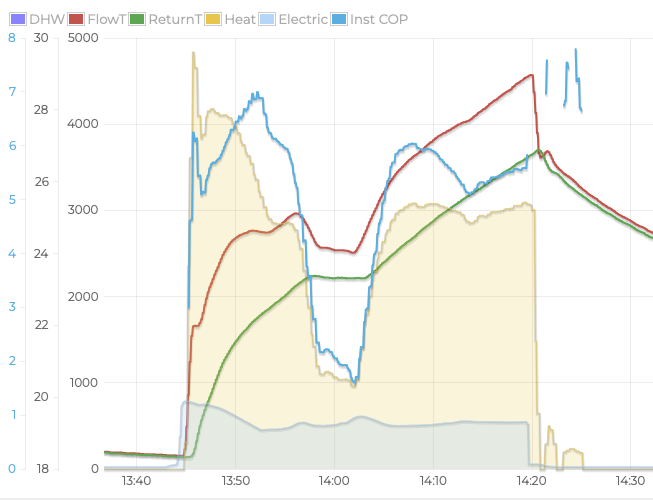
In mild weather, the initial two minute burst immediately gets the flow temperature above target. The compressor modulates down to the minimum level but it’s too late, the flow temperature keeps climbing. There’s an initial burst of heat, followed by a very pronounced dip in performance after the first 10 minutes. The heat pump reaches a steady state, with consistent heat output, after 20 minutes.
When short cycling, the heat pump doesn’t make it through the dip, resulting in a low coefficient of performance (COP) for the cycle as a whole. In contrast, if allowed to run for another 20 minutes at steady state, my heat pump achieves a COP well over 5.
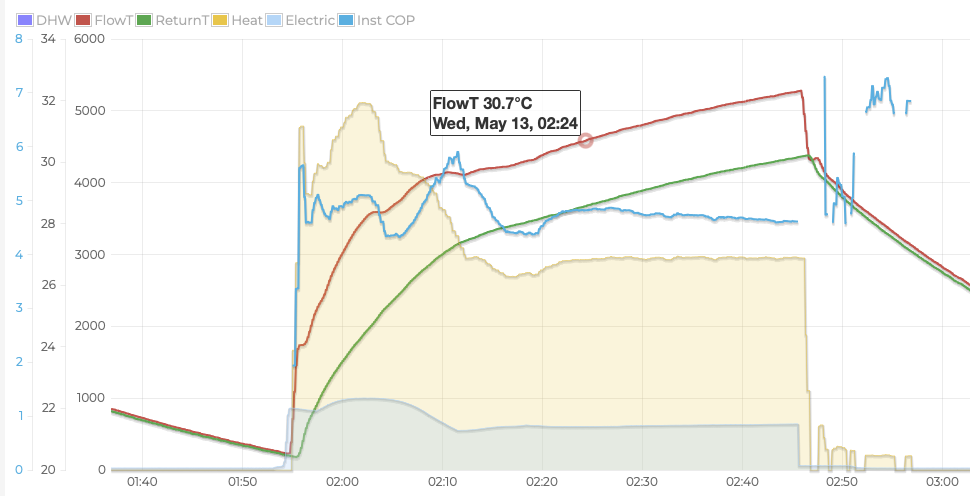
During colder weather, the flow temperature is still below target after the initial burst. The compressor ramps up aggressively until the target is hit and then modulates down. Of course, the flow temperature continues to sail up beyond the target because the compressor can’t modulate down enough. The dip is still there but much less pronounced.
Energy Integral
Energy Integral is the mechanism Vaillant uses to control cycling of the heat pump when the minimum modulation produces too much heat. Energy integral is implemented as a counter. Every minute the average difference between the current flow temperature and the target flow temperature is added to the counter.
If the current flow temperature is too high, the counter goes up. The heating cycle starts with the counter at -60 (can be configured in the settings). If the counter goes over zero, the heating cycle ends. If the current flow temperature is too low, the counter goes down. Once it reaches the starting value, another heating cycle can begin.
This system ensures that the average flow temperature matches the target, while smoothing out the effects of short term deviations in flow temperature.
Hacking the Heat Pump
I’m particularly annoyed by the heat pump’s behavior in colder weather. It wastes energy ramping the modulation up to exceed the target temperature as soon as possible. Then wastes more energy because the cycle is then shorter than it would otherwise need to be.
Is there some way I can hack the heat pump to force it to run at minimum modulation? Unfortunately, there are no settings that let you directly control the compressor level. Everything goes through the weather compensation and energy integral logic.
Then I read about Havenwise.
Havenwise
Havenwise is a cloud based system that takes over control of your heat pump. It uses the same myVaillant API as Home Assistant does. So, how does it work?
The flow of logic in the heat pump is as follows.
- Use Heating Curve parameter together with outside temperature and desired temperature to calculate target flow temperature.
- Clamp the target so that it doesn’t exceed the range defined by the Min and Max Flow Temperature parameters.
- Feed target and current flow temperatures into energy integral logic which decides how to modulate the compressor and when to end the heating cycle.
Havenwise sets the heating curve to its lowest possible value of 0.1. This produces a target flow temperature just above the desired temperature. Set a minimum temperature above that and you can directly control target temperature.
Havenwise sidesteps Vaillant’s weather compensation logic and uses its own to directly drive target flow temperature. However, it still relies on Vaillant’s energy integral logic to achieve the target flow temperature and handle cycling.
I want to go one step further.
One Step Beyond
The heat pump will cycle if you set target temperature below the minimum that the heat pump can produce. The heat pump will ramp up aggressively if you set the target temperature too far above the current flow temperature. The trick is to keep setting the target temperature to match the current flow temperature. This will avoid any aggressive changes in modulation and extend the cycle time indefinitely if you get it bang on.
The problem is that flow temperature is a moving target. The heat pump runs at minimum power (25% compressor modulation) and you get whatever flow temperature you get depending on local conditions. Even worse, it changes during a run depending on how effective your emitters are at using that heat. In my case, at this time of year, flow temperature at minimum power goes up steadily throughout the cycle.
I have to rely on Open Energy Monitoring (OEM) to determine flow temperature and state of the system (DHW, Heating or Standby). MyVaillant is too infrequently updated, with too high latency before changes are visible. My Open Energy Monitoring install includes a direct sensor on the ESBE valve to determine when the DHW circuit is active. For Heating vs Standby, I use the power consumption of the heat pump, treating anything over 400W as actively heating.
Managing the target temperature is a balancing act. I don’t want to update too frequently and hit Vaillant API rate limits. I don’t want to be too far above the current flow temperature and cause the heat pump to modulate up. I don’t want to be too far below as that will eat up the energy integral. Fortunately, my starting energy integral is configured to -100 which gives me more wiggle room.
After lots of trial and error I came up with an approach where I update the minimum flow temperature if the current flow temperature is over a degree different. I set minimum to 0.5°C above current and define a threshold where I will update minimum again another 0.5°C past that. The idea is that current flow temperature will be under target for the same amount of time that it’s over target.
The threshold is stored in a helper entity in Home Assistant with a trigger than runs an update automation whenever the current flow temperature goes above the threshold. This restricts updates to at most once per degree of increase.
Refining the Strategy
It almost works. The compressor settles at 25% modulation and the cycle length is extended. However, energy integral is still being consumed. It turns out that the temperature measured by OEM is less than the value reported in the Vaillant live monitor.
There’s lots of reasons why the values might not match. The sensors are in different places (in the airing cupboard vs in the heat pump). There’s 10 seconds latency on the OEM data but close to zero for the value used by the heat pump. The sensors aren’t explicitly calibrated to match each other.
The live monitor reports target flow temperature to the nearest 0.5°C. Testing confirms that the min flow temperature parameter used in the energy integral calculation is rounded down to the nearest 0.5°C. To save my sanity I made sure that the minimum I set is also rounded to 0.5°C. To account for the differences in temperatures measured by Vaillant and OEM, I biased the threshold so that the OEM value stays between 0.7°C below and 0.3°C above target.
I can now run for as long as I like at minimum power. However, I realized that the compressor doesn’t reach minimum modulation until steady state running, 20 minutes into the cycle. Unsurprisingly, if you keep target close to actual, the Vaillant controller will keep modulation steady. It only drifts down gradually as, on average, flow temperature is slightly over target.
I switched strategy for the first 30 minutes of a cycle. Whenever electrical power is above 600W, we set the target flow temperature just below the current flow temperature, forcing the compressor to modulate down. Energy integral is consumed, but slowly. The heat pump ramps down to minimum modulation straight after the initial burst.
The Dip
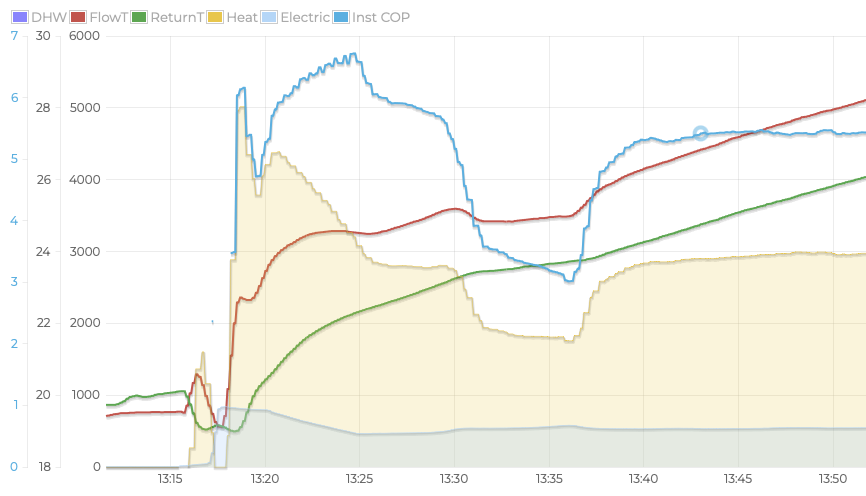
I’m pretty close to creating my perfect heat cycle. However, it still has a dip in performance ten minutes after startup. I’ve become obsessed with figuring out why. It’s not just my heat pump. You can see the same thing for lots of other Vaillants on HeatPumpMonitor.org.
There’s also lots of Vaillants that don’t have a dip. They have the same initial ramp up of power, but then fall gracefully back into a steady state. It’s also weather dependent. The dip is most pronounced during mild conditions, as it gets colder (6°C in this example), it becomes more of a plateau.
After comparing a lot of different systems, I have some theories, but no solutions. I think it all comes down to system design. If you have low system volume, and a minimal set of emitters, you’re likely to have a dip. Simple open loop systems with radiators, like mine, have dips. Large houses with underfloor heating don’t.
The Theory
At the start of a cycle, flow temperature shoots up as the compressor is driven to an initial 40% modulation. My system quickly establishes a deltaT between flow and return of 3.5°C. It then takes two minutes before the return temperature goes up.
The system flow rate is 20L/min, which means there’s 40L of water in the pipes on the shortest path around the heating circuit. It’s an open loop system with radiators. The radiators have a volume of 50L, for a total system volume of 90L.
It’s important to understand the limitations of the monitoring system. Flow temperature is measured as water leaves the heat pump and enters the heating circuit. Return temperature is measured as water leaves the heating circuit to return to the heat pump. The assumption is that heat emitted into the house is (FlowT - ReturnT) * Flow Rate * Specific Heat Capacity. In particular, that the deltaT between flow and return is due to heat transfer into the house from your emitters.
This is only true when you’ve reached a steady state after startup, or when looking at the heat cycle as a whole. The first five minutes of the cycle is a great example. It looks like there’s a massive spike in heat with better performance than any other point in the cycle. When I first saw this, it made me wonder whether I should restrict the heat pump to running for five minutes at a time.
In reality, there’s virtually no heat emitted in the first few minutes. It takes two minutes for any of the hot water entering the heating circuit to make it to the end of the circuit. During that time you’re just measuring the deltaT between the incoming hot water and the cold water that’s been sitting in the pipes and radiators. It takes around five minutes before all of the cold water has been displaced and the heating circuit is up to temperature.
After the first two minutes, flow temperature goes up rapidly. It’s easy for the heat pump to raise the temperature of the returned water by 3°C, even as it’s ramping down. However, once all the cold water has gone, flow temperature flattens out and deltaT narrows to a more normal 2°C. Vaillant heat pumps maintain a constant flow rate with an expected deltaT of 2°C at low flow temperatures and up to 5°C at high flow temperatures.
At this point all the water in the heating circuit has passed through the heat pump once. The momentum from that initial round trip keeps going, with flow and return temperatures rising in tandem. Flow temperature is rising faster than the heat pump can sustain. After five minutes and another round trip, the momentum has dissipated. The heat pump finally has to pay back the initial rapid rise in flow temperature. We hit the dip.
The Physics
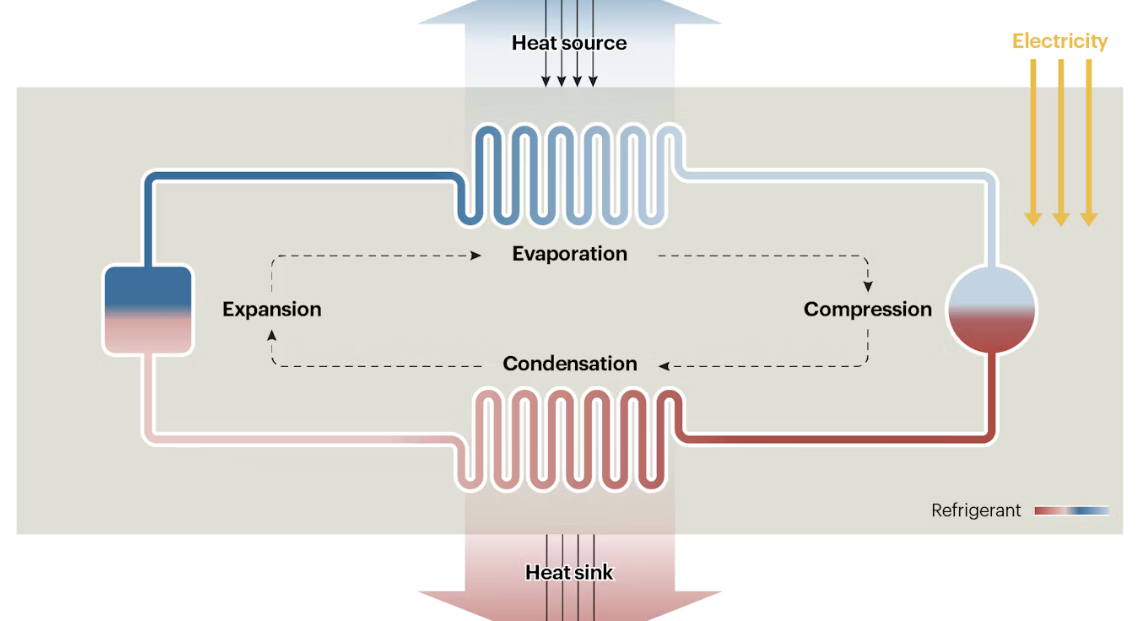
Heat pumps work by pumping refrigerant around an evaporate/condense cycle. The refrigerant liquid expands and evaporates, drawing heat from the air. The refrigerant gas passes through the heat pump’s compressor causing it to condense and release the captured heat.
As flow temperatures go up and the heat pump needs to work harder, more refrigerant is drawn into the circuit from an internal reservoir. Some of the energy that would otherwise go into heating water is used to bring the additional refrigerant to the correct operating conditions.
The heat pump has been riding the initial wave of hot water, not having to work too hard. When the momentum dissipates and it has to sustain the current flow temperature all by itself, it doubles down, pulling in more refrigerant which temporarily means less heat output. If the drop in flow temperature is significant, the heat pump’s logic will respond by increasing compressor modulation, which makes the dip worse.
If you have more system volume, everything happens more slowly, you don’t get the same momentum effects. Flow temperature rises less rapidly, the heat pump gradually builds up its effort.
If you have more emitters, less heat is returned to the heat pump on each cycle, and the heat pump can maintain a low flow temperature.
If it’s cold outside, and the heating has been off, the starting flow temperature is lower. The whole startup sequence happens at lower temperatures and the dip is reduced. Some of my overnight runs have barely any dip at all.
Managing a Full Cycle
That was a large digression, but one with a simple conclusion. The heat pump needs 20 minutes to reach a steady state and start to pay back the startup costs. In my case, I want each cycle to last at least 40 minutes.
I start a heating cycle when the current temperature is below a threshold. I end the cycle once the heat pump has been active for at least 40 minutes and the current temperature is above a threshold.
I can’t just turn the heating off to end the cycle. If you do, the pump stops running and you waste the heat that’s built up in the circuit. I need to keep the pump running until the residual heat has been emitted.
I leave the target flow temperature at it’s last value so that the energy integral keeps going up as flow temperature falls. I don’t want the energy integral logic to start another heating cycle before I’m ready.
Once the flow temperature falls below 23°C, I turn the heating off. Once the current temperature falls below my threshold range, I turn the heating back on. Fortunately, Vaillant resets the energy integral counter back to its starting position as long as the heating has been off for a few minutes. The new cycle starts immediately.
Premature End of Cycle
On rare occasions a heating cycle may end prematurely. Perhaps I didn’t manage the energy integral well enough, or maybe Vaillant’s API had an outage and I failed to increase the minimum flow temperature when needed.
If the heat pump goes inactive and the current temperature is still below threshold, I drop minimum flow temperature to 20°C. This brings down the energy integral quite rapidly. Typically, the heat pump will start a new cycle after 20 minutes or so, at which point I start managing minimum flow temperature again.
DHW
In normal operation, with heating on all the time, energy integral update is suspended during a DHW run. Obviously, the house is still losing heat during these periods, so it’s infuriating if the heating doesn’t come on immediately when the DHW run ends. The heat pump is already running and the house is below temperature. There’s no compressor startup to go through if the heating picks up immediately when the DHW cycle ends.
My automation turns the heating on (if not on already) whenever a DHW run starts. The energy integral resets and the heat pump naturally transitions into heating when the DHW run ends.
Startup behavior is very different when transitioning from DHW into Heating compared with Standby into Heating. For the DHW case, flow temperature can be 60°C or more. This stays steady for the first 30 seconds of the heating cycle until cold water from the radiators reaches the heat pump, at which point the flow temperature plummets.
We wait until the flow temperature is below 35°C, then wait until flow temperature starts to climb again. Updating minimum flow temperature to track current flow temperature is too risky for the first few minutes after a DHW run. What happens if I set min flow temperature to 65°C and then Vaillant cloud access goes down and I’m left with heating running full blast?
The compromise is to use 35°C as an initial value. This will take a significant chunk from the energy integral before bottoming out. At this point we resume updating minimum flow temperature. As long as we can hold the integral steady after that, it works OK.
Locking On
As the weather has turned colder over the last few days, my heating cycles have extended to the point where the flow temperature stops rising. The heat pump has found a flow temperature that it can sustain at minimum modulation. If this is above the target temperature, energy integral will be consumed and the heating cycle may end prematurely.
I need to find the lowest flow temperature that is a multiple of 0.5°C and that the heat pump can lock onto. I updated my strategy so that if the current flow temperature settles in the range between minimum and threshold, and is more than 0.15°C above target, I push minimum up another 0.5°C.
Typically, compressor modulation will end up slightly above minimum, at 26% or 27%. This lets the heat pump modulate slightly up and down to stay locked onto the target temperature.
In the worst case, with a flow temperature continually 0.15°C above target, it would take 11 hours to burn through 100 energy integral.
Compare and Contrast
Here’s a comparison of two cycles using normal Vaillant logic and what I’m calling shoulder mode. Finding equivalent conditions was tricky. Eventually I found two cycles at similar times of day, a consistent 4.5°C outside, 16.8-17.2°C inside. There are light winds, an overcast sky, and no solar gain.
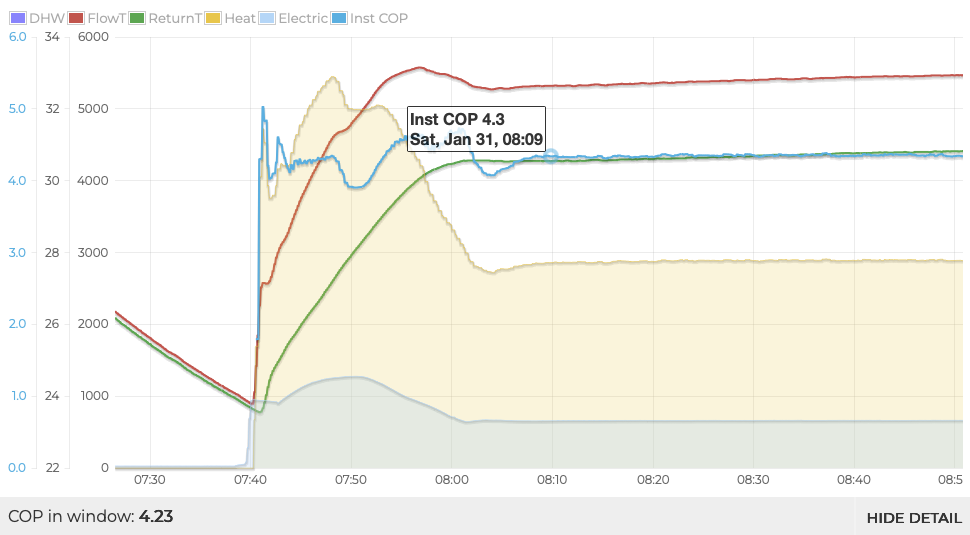
The normal heating cycle looks great. Consistent heat output and electricity use once we hit steady state. Barely any dip. The standard Vaillant logic ramps the compressor up to quickly get to target flow temperature, then ramps down once it overshoots. The dip coincides with the compressor modulating down, when the heat pump has plenty of spare capacity.
The downside is that COP after 30 minutes, when the system has settled into steady state, is only 4.3. Electricity consumption peaks at 1250W before falling back to a steady 650W. The overall COP for an hour’s running time is 4.23.
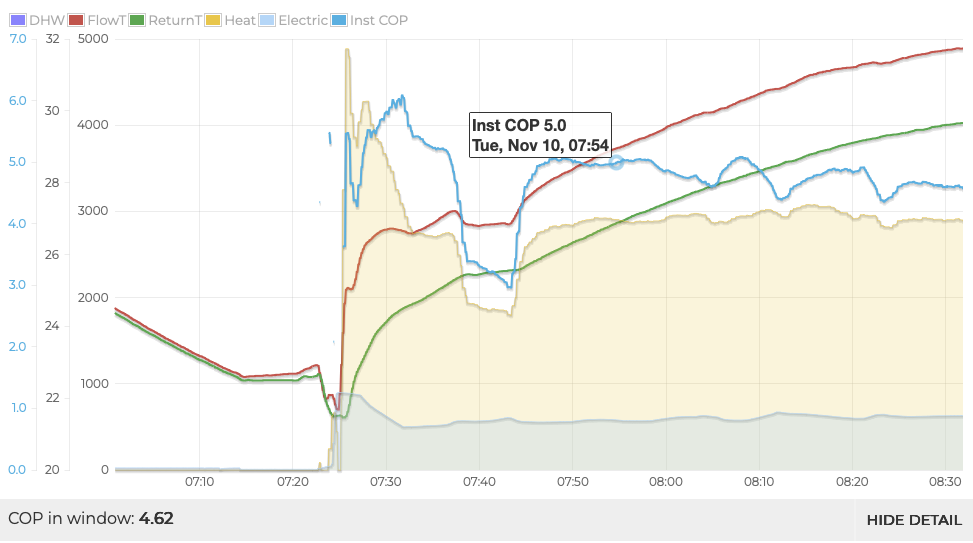
The shoulder mode cycle looks more messy with a pronounced dip. Flow temperatures are kept as low as possible, only getting close to the normal cycle after an hour’s running time.
The COP after 30 minutes is 5.0. Electricity consumption peaks at 850W before falling back to 500W and then steadily climbing with flow temperature over the course of an hour to 650W. The overall COP for an hour’s running time is 4.62.
Conclusion
I’ve been running in shoulder mode for a few weeks. It’s been working well. I’m consistently getting heat cycles with COP well over 5.
There are less cycles overall, no short cycles and no pointless heating cycles when there’s high solar gain. The indoor temperature stays within a 0.4°C range.
The longer time between cycles also means lower flow temperatures at the start of the next cycle and so more time spent at efficient low flow temperatures.
Initially, I thought I’d turn the heating on properly once the weather turns consistently cold. Now I’m wondering how far I can push things.
To be continued.